Take the guesswork out of email deliverability
Make every message count by sending it straight to the inbox.
Get started
Litmus Deliverability is now part of Validity EngageEverything you need to reach the inbox—in one place.
Engage unifies email creation, testing, deliverability, and contact data quality on one agentic platform—built to improve your program with every send.
Check out Validity EngageIndustry-leading deliverability insights—packaged into an easy-to-use experience









Find and fix what’s sending you to the spam folder
Get more messages to more people
View deeper sender reputation and email metrics—beyond what your ESP shows.
Stand out in a crowded inbox
Ensure your content is timely, engaging, and functions on any device.
Find and fix deliverability threats
Get ahead of blocklists and spam traps with alerts that protect your performance.
Join the 700,000 users that trust Validity








A data network that’s second to none.
Better data fuels smarter decisions. We process over 2.5 billion email data points per day to give you clear, actionable insights so you can boost inbox placement and get more from every send.
Get StartedFeatures designed for the world’s largest senders
View inbox placement insights
See which mailbox providers are sending your emails to spam.
Quickly run infrastructure checks
Track SPF, DKIM, and DMARC results to keep your emails secure.
Create customizable alerts and dashboards
Find deliverability risks in real-time and fix them quickly to protect your inbox placement.
Get deeper engagement analytics
Learn when emails are opened, what devices they’re opened on, and how long people are looking at them.
Connect your tools
Integrate with your ESP to monitor holistic email performance in one spot.
1440 achieves a ~100% inbox placement rate with Validity’s deliverability tools.
“It can be hard to know what happens once you hit send if you’re not an email expert. But the consistent validation that our reputation is high and the heads-up about areas that could negatively impact our program gives us peace of mind.”
Mitchell Kapoor
Vice President of Product and Growth at 1440

Deliverability is just one piece of a great email program.
We’re the only platform that helps you optimize every part of your email before you hit send.
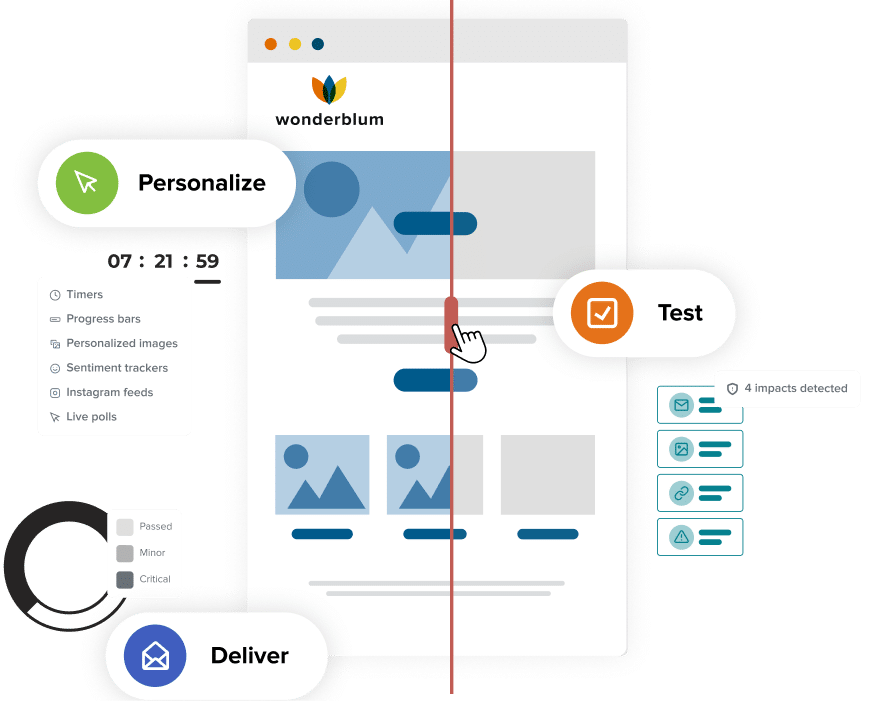
- Build connections that last using personalized content.
- Send with confidence knowing your emails are error-free in 100+ clients.
- Understand your subscribers’ behavior better with advanced analytics.
Dive into our must-read email deliverability resources
Check out a few of our favorite articles and guides related to email deliverability and spam testing.
Frequently asked questions
The most reliable way to check if your emails are being sent to spam is to monitor your inbox placement rate (IPR) using tools like Litmus from Validity. IPR is the percentage of your emails that make it to the inbox and not the spam folder. You should also check your spam complaint rate, the percentage of recipients who mark your emails as spam, to keep your inbox placement rate healthy.
There are a few free tools to check if your sender reputation is in the green. Our favorite is Sender Score. It works like an email credit score to help you assess where you are today and where there’s room for improvement. Any legitimate, permission-based senders should aim for a Score of 100.
Monitoring email deliverability is crucial for email marketers to ensure their messages are reaching subscribers’ inboxes. Here are some key metrics you should track to monitor email deliverability effectively:
- Inbox placement rate (IPR) is the percentage of successfully delivered emails that reach the inbox instead of spam. It’s a critical metric that isn’t surfaced by traditional ESPs.
- Delivery rate tells you whether or not your emails were received by the servers of your subscribers’ mailbox providers. This metric does not reveal if these messages were delivered to the inbox or the spam folder.
- Bounce rate measures the percentage of emails that were not delivered successfully due to various reasons, including invalid email addresses, full mailboxes, or server issues. There are two categories of bounces: hard bounces (permanent delivery failures) and soft bounces (temporary delivery failures).
- Click-through rate (CTR) indicates the percentage of recipients who clicked on your email out of the total number of emails delivered successfully. While CTR rate doesn’t directly measure deliverability, it reflects email engagement, which can impact email deliverability.
- Spam complaint rate measures the percentage of recipients who marked your emails as spam or junk. High spam complaint rates can negatively impact your sender reputation and email deliverability.
By tracking these key metrics and analyzing trends over time, you can identify areas for improvement and enhance your overall email deliverability.
Avoiding spam traps is crucial for maintaining a good sender reputation and ensuring high email deliverability rates. Here are some ways to help you avoid spam traps:
- Use permission-based lists: Only send to subscribers who have explicitly opted in to receive communications from you. Do not use purchased or rented lists, as they often contain outdated or invalid email addresses that have been converted to spam traps.
- Maintain list hygiene: Implement a strict email re-engagement and suppression policy to avoid sending to old, inactive addresses, while taking proactive measures like email validation to combat data decay, identify problematic, undeliverable addresses, and protect your sender reputation—especially during a re-engagement initiative or key campaign.
- Verify email addresses: Implement a double opt-in process (DOI) where subscribers must confirm their email addresses after subscribing to your emails. This helps ensure that email addresses are valid and owned by real individuals, reducing the likelihood of hitting spam traps. You can also implement a solution providing real-time contact verification to identify invalid addresses at the point of capture.
- Follow email best practices: Adhere to email best practices, like using accurate subject lines and including a visible unsubscribe link in your emails as well as a one-click unsubscribe header. Comply with anti-spam laws such as the CAN-SPAM Act and GDPR to maintain trust and credibility with subscribers and mailbox providers (MBPs).
Getting off a blocklist can be a challenging but necessary process to restore your email deliverability and sender reputation. Here are some steps you can take to get off a blocklist:
- Identify the blocklist: Determine which blocklist you have been listed on using online tools like Sender Score’s Blocklist Lookup tool.
- Investigate the reason for listing: Once you’ve identified the blocklist, investigate the reason why your IP address or domain was listed. Common reasons for listing include a high volume of spam complaints, poor email authentication practices, or compromised email accounts.
- Request removal: Most blocklists provide a process for requesting removal. Visit the website of the blocklist that listed your IP address or domain and follow their instructions for removal. You may need to provide information such as your IP address, domain name, and details about the actions you’ve taken to resolve the issue.
- Monitor your reputation: After requesting removal, monitor your email deliverability and sender reputation closely. Keep an eye on bounce rates, spam complaints, and other deliverability metrics to ensure that your emails are reaching recipients’ inboxes.
- Implement email authentication: Implement email authentication protocols such as SPF, DKIM, and DMARC to protect your sender reputation. Proper authentication helps verify the legitimacy of your emails and reduces the risk of being listed on blocklists.
- Be patient: Getting off a blocklist may take time, and it may require multiple attempts to request removal. Be patient and persistent in your efforts to resolve the issue and restore your sender reputation.
By following these steps and addressing the underlying issues that led to the listing, you can improve your chances of getting off a blocklist and restoring your email deliverability and sender reputation.