Key takeaways ✨
|
Gary Thuerk holds a special place in marketing history for sending the first mass email message in 1978 to 400 customers. His innovation also earned him a new title: The Father of Spam.
Sparing a debate about whether Gary’s moniker was justified, his strategy was innovative, ambitious for the time, and ultimately, effective.
Of course, email marketing has significantly evolved since the ’70s, and so have customer expectations. With the average person receiving over 120 emails per day, it’s understandable for your customers to reserve their time only for messages that demand their attention. It’s a competition to stand out in your subscribers’ inboxes, but you don’t want to capture their focus for the wrong reasons.
To help your team break through with email marketing—and avoid being seen as a spam factory—here are 10 email optimization tips that are sure to improve your results.
Table of contents
- The impact of email optimizations
- Use eye-catching subject lines
- Segment your users
- Automate your messages
- Add shareable links
- Craft compelling copy
- Make it easy for people to unsubscribe
- Optimize for all devices
- Focus on personalized messaging
- Have a clear call to action
- Optimize your A/B testing
The importance of email optimization
If you’re unfamiliar with the term, email marketing optimization refers to the various processes, considerations, and best practices used to improve your email marketing success. By optimizing your emails, you can meaningfully increase your open, engagement, and conversion rates, helping you earn loyal subscribers.
The impact of email optimization
At its core, email optimization is a win-win: your customers receive relevant, useful information and a better email experience, and your business earns loyal shoppers and a boost in sales.
Many retailers make the mistake of sending the same email to their entire subscriber list at the same time, unaware that this hurts their long-term email marketing results.
In fact, the majority of consumers—76 percent—are frustrated when emails aren’t personalized. But we also know that personalizing at scale isn’t easy, with 16 percent of marketers naming it as their top operational challenge in 2025.
The truth is every subscriber on your list has unique shopping needs and preferences for how they interact with your brand. Failing to personalize your content and delivery only shows your customers that you don’t care about them as individuals. If you continue to deliver generic and impersonal emails, your customers will eventually unsubscribe and stop shopping with you altogether.
Email marketing optimization can help you avoid unnecessary list churn and increase your email open rate, making it a valuable marketing asset.
10 best practices for email optimization
Understanding the stakes at play with your email marketing is the first step in leading an effective email marketing strategy. But as the saying goes, it’s much easier said than done.
To help you simplify planning and see an immediate improvement in your performance results, follow these ten email optimization best practices.
1. Use eye-catching subject lines.
Look at your email inbox. Of the hundreds of emails, which ones stand out to you?
An email subject line is the first (and possibly the only) part of your email that customers read, so you need to use something eye-catching that demands attention. Test multiple subject line styles and consider including your customer’s name in the subject, using emojis to personalize the message, or both. Be conscious of how long your subject line is, too, because you want to get your point across quickly and avoid truncation that occurs when your subject line is too long for a particular mailbox provider.
These days you also have to think about how AI in the inbox might change your subject line based on your email’s content.
AI-powered email intelligence
Built on the world's largest email data network, Validity Engage removes risk and boosts email performance—so you can produce exceptional results in less time.
2. Segment your users.
To reinforce a previous point, each of your email subscribers has a unique history with your brand and specific ways they prefer to engage with you. It’s essential to segment your subscribers to deliver the right message to specific groups of recipients.
There are several ways you can segment your email subscribers, including:
- Demographics: age, gender, career, or title
- Engagement: when a subscriber last engaged with your content
- Location: sending emails that spotlight regional content and offers
- Past purchases: promoting a complementary product based on a recent purchase
To maximize results, your should use your customer data to continually assess and refine your email marketing audience segments. As consumer privacy laws continue to tighten up, the best way to collect these consumer data points is with an email preference center.
3. Automate your messages.
Even if you work around the clock, it’s impossible for your team to manually send every email to your customers. You need to automate your email marketing to ensure customers get your messages when they matter most and will make the most impact.
Review your customer journey map and identify the many touch points between your brand and your customer. How can emails help remove challenges and drive action from your customers throughout their journey?
Create automated message campaigns to address your most common or stressful customer situations tied to events in the customer journey, such as sending automated shipping and delivery notifications or using automated messages to onboard your new loyalty members.
Marketers will typically see the best results from implementing an email marketing tool that allows you to pre-schedule messages and set up an automated message series to make the process effortless for your team.
Protect your email reputation
Catch issues before they reach subscribers with real-time alerts whenever a link breaks, an image dies, or a client update breaks your render.

4. Add shareable links
Email is a great way to share information in a highly customizable and visual way. Include shareable links in each of your emails to create a journey for your customer and help them promote your brand.
Link to your brand’s social media channels, as well as brand pages or websites, in your emails. You should also provide a link for people to sign up for your emails in case they’re viewing a forwarded version of your email.
5. Craft compelling copy
One of the biggest challenges in email marketing is creating engaging email copy. Why should people read your emails? How does your brand personality shine through in every email you send?
Your email content will play a strong role in getting your subscribers to engage. Just like with your email subject lines, test different copy styles and present your email content in different ways to learn the best approach for your subscribers. It helps to focus on just one core message for each email so you can ensure every sentence and email element supports that message and goal.
6. Make it easy for people to unsubscribe.
Nobody wants to lose an email subscriber. But if you don’t give your subscribers an easy way to opt out of your emails, they’ll likely mark your message as spam or block your email address. If too many people mark your messages as spam because they couldn’t unsubscribe easily, certain mailbox providers may choose to block your emails entirely. Include a clear unsubscribe link at the bottom of every email you send. And don’t try to hide it—position the link prominently in the email header or footer.
7. Optimize for all devices.
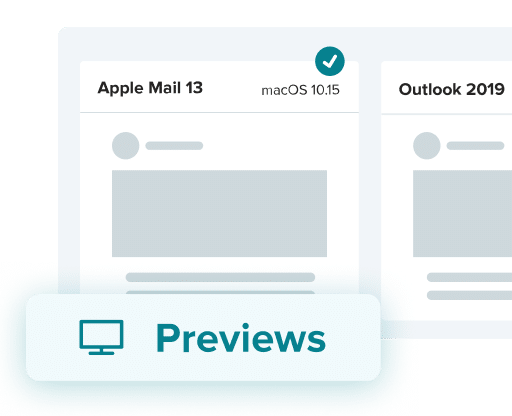
An important part of email optimization is optimizing for multiple devices. Some of your customers will never read your emails from a computer. Many people read email exclusively on mobile devices—including cell phones and tablets—given their increasingly on-the-go lifestyles. Optimize your email marketing so your messages render appropriately across devices. Do all images load properly? Is your design clean across devices? If you fail to test your emails across devices, then the experience may be poor and cause your subscribers to mark your messages as spam.
Indistry-leading email testing
See what your emails look like in 100+ email clients and catch errors—like Dark Mode misses and accessibility fails—before sending.
8. Focus on personalized messaging.
We’ve mentioned you should provide each subscriber with messages tailored to their needs. Put another way, you should personalize your email messaging by using your customer data. Combining segmentation and personalization allows you to create targeted and relevant content—beyond including your subscriber’s first name. More advanced tactics include changing the email content to reflect the subscriber’s age, location, shopping history, and other data you’ve collected from them.
Get your team onboard
Get your request for Litmus approved—by the whole team—with these easy-to-reference talking points.
9. Have a clear call to action (CTA).
Every email you send should have a clear goal and intended action from the reader. Include a CTA in all of your emails so your subscribers understand what they should do with the information you’ve shared. Think past basic CTAs like “click here” or “act now,” and instead reinforce the value your reader will get with descriptive CTAs. Phrases like ”start your 30-day free trial” or “shop these 10% off savings” clearly explains what the reader will get when they click.
Using descriptive CTAs is also an accessibility best practice, allowing everyone to enjoy your email. Get more accessibility tips from our 2026 Litmus Live session titled “Accessibility is personalization: 3 email mistakes still breaking UX in 2026.”
10. Optimize your A/B testing.
Your email marketing success will ride on your ability to appropriately A/B test your emails. Send version A of your email campaign to one portion of your email list, then send version B of that same email campaign to a separate portion of your list. Afterwards, compare your KPIs for each.
You can test everything from your font size or color, image placement, copy, call to action, subject line, and anything else about your email. Keep in mind that you’ll need to A/B test specific elements over time—it’s hard to see what’s working if you test too many elements at once. Check out this post for email A/B testing examples, tips, and ideas.
Grow your email marketing strategy
As you keep sending personalized emails, you’ll see higher levels of engagement, a steady rise in opens, and a boost in your sales. Keep an eye on your email marketing metrics to assess how your campaigns perform and watch for signs that your strategy may need a tune-up.
Although email optimization is a key factor in your email marketing success, there are a few other current challenges that make succeeding in this email landscape difficult, including consumer privacy laws, constant mailbox provider changes, and more. Check out Litmus’s many resources to help you boost your email marketing strategy and ROI.
Learn from the experts
Sign up for one of Validity's free virtual events all about email marketing and AI, or watch one on-demand.

This article was originally published on Validity.
The info in this blog is 2+ years old and may not be updated. See something off? Let us know at hello@litmus.com.

Lindsey is a Sr. Content Marketing Manager at Validity.