Key takeaways ✨
|
Artificial intelligence is what every email geek is talking about right now. (Hello from the human writing this piece! If I had a dollar for every time I read the word “AI” on the internet I’d be lounging on a yacht in St. Tropez with Beyonce right now, but alas, onward with email.)
The thing with AI is that it can be used in so many different ways that it’s completely upending the traditional email marketing workflow. 70% of email marketers we talked to for the State of Email Report 2025 say that up to half of their email marketing operations will be AI-driven by the end of 2026.
But as exciting as this new frontier is, it’s brought to surface a multitude of legal, ethical, and social concerns that have yet to be addressed with AI as it stands today.
So, what’s the “right” way to use AI in email marketing? In this blog post, we’ll examine the ways email marketers can incorporate generative AI into their email programs while adhering to some guiding principles that come back to what matters the most: your audience.
Table of contents
- What is AI in email?
- How generative AI is reshaping email marketing
- How is AI regulated today?
- How to use AI for email marketing
- How to use AI in email responsibly
- Get started using AI for email
- How to get started using AI for email
What is AI in email marketing?
AI in email is the use of artificial intelligence to concept, create, or execute email marketing campaigns. Most of the AI that’s used in email marketing falls into the “limited memory” category, which we’ll talk about in a moment.
“AI” is a bit of a catch-all term, especially when we’re talking about marketing automations or email marketing. AI isn’t actually that new. Remember when IBM’s Watson beat Jeopardy! champion Ken Jennings? But what changed is the release of DALL-E 2 and ChatGPT in 2022. Since then, AI has been widely available to the public, making us part of what’s basically the world’s largest beta test.
Our current understanding of artificial intelligence is still “narrow,” meaning it’s designed for a specific task, or range of tasks, rather than producing thought. When ChatGPT responds to your input, it’s just putting together words that often go together—it’s not actually thinking…yet.
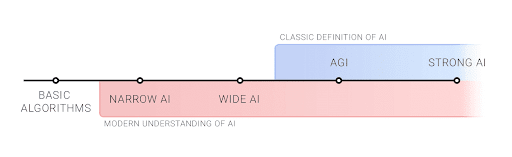
Within the narrow-strong spectrum, AI can be categorized into four main types, based on functionality. What’s changing now is that we’re moving beyond basic algorithms and machine learning to generative functionality that unlocks so much more opportunity for email marketers. Each one of these types has relevant applications for email marketing:
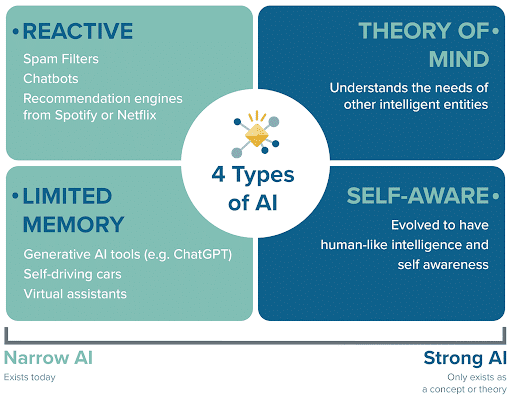
- Reactive: Reactive AI algorithms can respond to various inputs, but lack memory-based functionality to learn from previous encounters. (This means they lack the ability to use past experiences for decision-making.) These algorithms are one of the oldest and most basic forms of AI systems. Examples include spam filters, chatbots, or product recommendation engines.
- Limited memory: The next level is limited memory AI. It encompasses the capabilities of reactive AI with the added ability to temporarily store data from past experiences, allowing it to leverage historical data for decision making. Limited memory AI is what powers a wide array of contemporary AI applications. This includes: Generative AI tools (e.g. ChatGPT), self-driving cars, and virtual assistants.
The remaining two types don’t actually exist today:
- Theory of mind: Theory of mind AI refers to the capability of algorithms to attribute mental states to the entities they interact with. It has yet to be fully developed, but is paving the way for emotionally intelligent robots that resemble humans in conversation. These AI systems will make decisions based on understanding and remembering emotions, adapting their behavior accordingly during interactions. Think human-like robots.
- Self-aware: Self-aware is the most advanced type of AI and usually what we see in sci-fi flicks like Her or 2001: Space Odyssey. As the name suggests, it’s an AI that has evolved to be on par with human intelligence, so much that it’s self-aware.
When we talk about the kind of artificial intelligence that’s making an impact on email, though, we’re usually talking about generative AI.
How generative AI is reshaping email marketing
Let’s focus on the main type of AI that email marketers use: generative applications. Our survey for the State of Email Design report found copy creation tools to be more popular than image-only tools, with the conversational model of ChatGPT appealing to most email marketers.
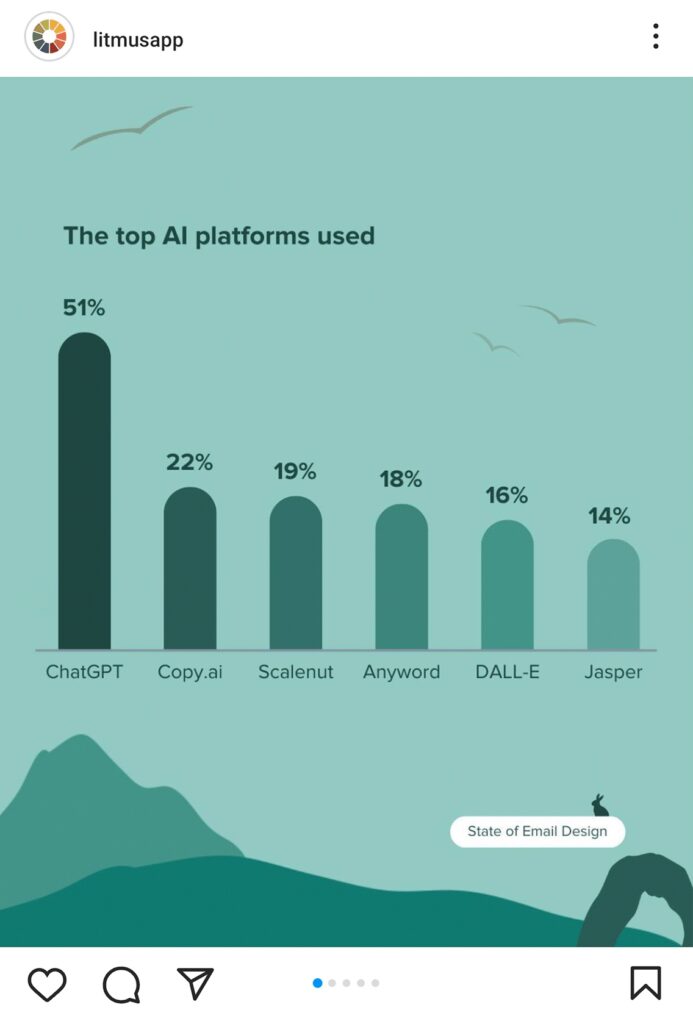
Source: Litmus’ 2023 State of Email Design, as seen on Instagram
- ChatGPT: 51%
- Copy.ai: 22%
- Scalenut: 19%
- Anyword: 18%
- DALLE-2: 16%
- Jasper: 14%
In 2025, we saw a 340% increase in marketers using genAI for tasks like copy and image generation, personalization, analyzing campaign performance, and A/B testing.
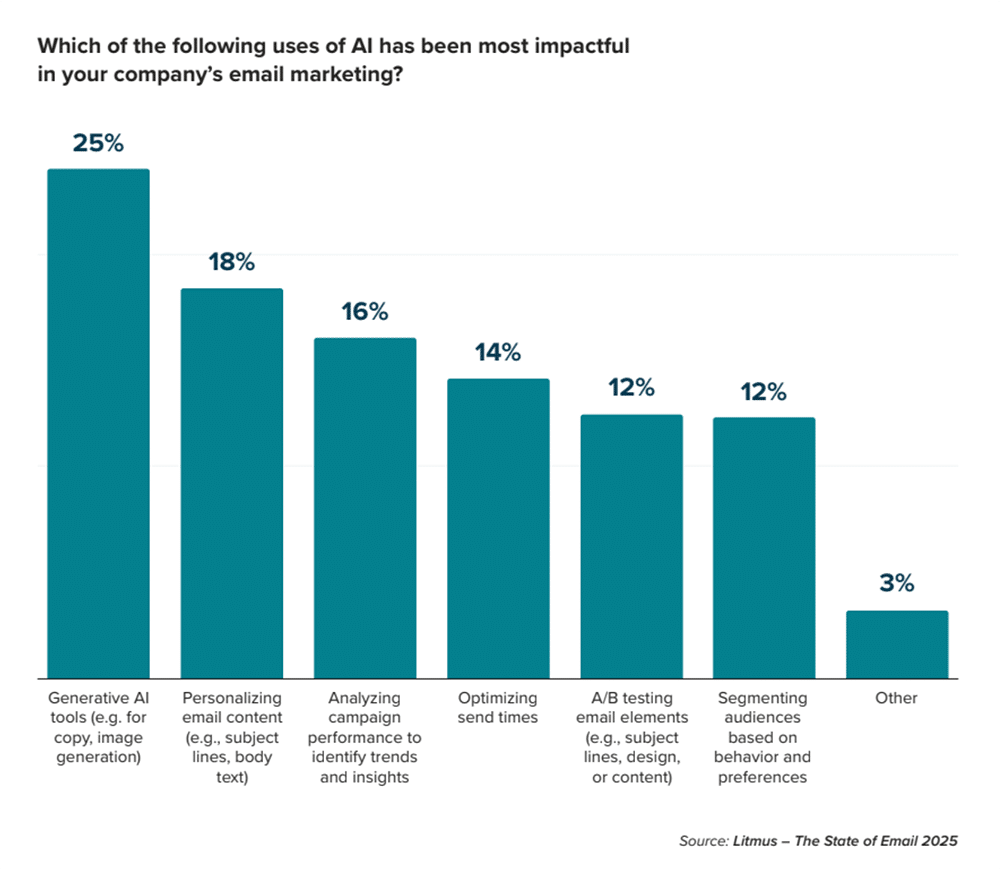
More than anything, the use of AI is speeding up the email workflow. Case in point: When we asked email marketers about their email processes for our annual State of Email survey in 2024, 62% of teams said they needed two weeks or more to produce a single email. That number in 2025? It dropped to only 6%. 🤯
That makes it much, much easier to get emails out the door. In fact, global send volumes are at an all-time high.
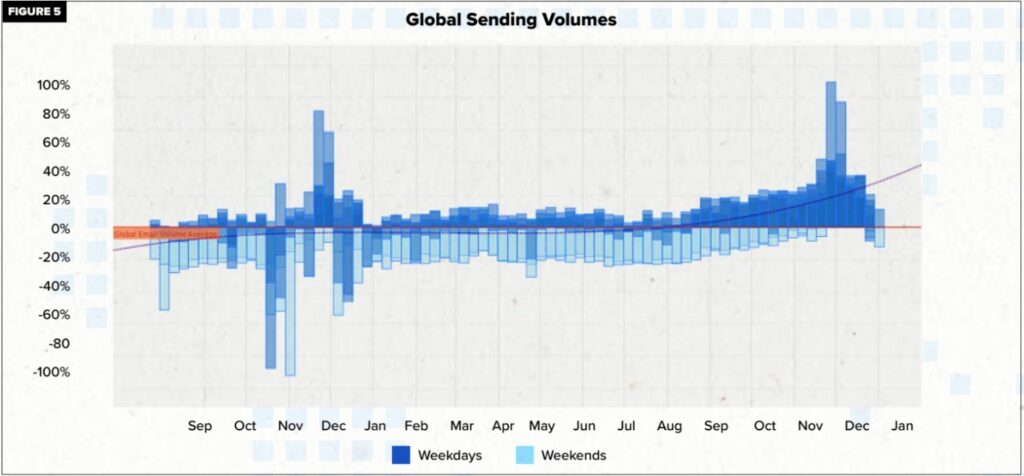
But this speed comes with its own consequences. According to Validity’s 2025 Deliverability Benchmark Report, we’re seeing a downstream impact of using AI on inbox placement, partially because mailbox providers have added their own AI features like summaries or annotations, and partially because AI has made it so much easier for spammers to send emails that it’s eroding trust in legitimate senders and making ISPs tighten up their protections.
How is AI regulated today?
Right now, AI is so new and moving so quickly that lawmakers are struggling to keep up. When you think about the regulations that apply to email marketing, though, it’s more about data privacy and protection for consumers and less about the use (or not) of AI in a marketing context. Here’s what you need to know:
| Region or Country | Applicable Laws | Action Items |
|---|---|---|
| The E.U. | EU Artificial Intelligence Act | While the act mostly applies to AI developers, it follows similar legislation like GDPR in establishing clear data privacy rules for consumers and reducing bias with advertising targeting (e.g., job ads). |
| The United States | Federal and state-level AI-related legislation | While there are no specific AI-related laws at the federal level, existing laws are being applied to AI use. For example, the Federal Communications Commission declared that using AI-generated, pre-recorded voices falls under the Telephone Consumer Protection Act (1991). Additionally, states like Arkansas, Colorado, California, and Montana have passed AI legislation. |
(*Remember, we’re just humble email geeks and not lawyers, so please consult legal advice when it relates to these kinds of regulations.)
There are many, many more legal protections in the proposal stage around the world in an effort to put guardrails on developers to prevent data mishandling, bias, and discrimination. While we’re all still in the process of figuring out what regulations we should implement around AI, the conversations around what is legal and ethical in the industry are happening, and there’s more to come. The takeaway is essentially that it will probably end up being regulated more in the U.S., but the how, when, and where remain to be seen.
How to use AI for email marketing campaigns
When we think about AI, we often jump straight to copy and imagery—and those are certainly great use cases. But honestly? The best ways to use AI right now fall under repetitive, data-driven tasks, rather than taking over your creative direction.
Here’s how successful marketing teams are using AI right now:
1. Mine your email list for insights that power a customer-centric email marketing strategy
AI is best at continuously identifying patterns in massive amounts of unstructured data in real-time. You know, the kind of task that would take hours of staring at your ESP’s exported spreadsheets to figure out? If you’re struggling with first-party data or don’t have systems that integrate and match third-party data easily, AI can help you bridge the gap.
When you’re talking to your customers in a lot of different places—website, email, social media, and so on—you end up with a lot of different data streams. Some of them might include incomplete or incorrect information. Maybe one subscriber only volunteered her contact information over email but not on her account profile. Or someone else made a typo during account creation on the website or created and abandoned multiple separate accounts over the years. AI can help unify this customer data into one place for sales, marketing, and customer support. This way, you can see a more holistic profile of each person that interacts with your business and then ask AI questions to find insights, patterns, and connections that reach across your disparate data streams.
Once you have AI connected to your customer data, you can ask it things like:
- What types of content are most likely to convert a subscriber to a customer?
- What topics do email subscribers engage with the most?
- What questions do customers have about our products?
- What are the most common objections customers have during sales calls?
- What makes a customer leave our subscription or stop engaging with emails?
2. Generate email campaign ideas that subscribers will engage with
Training AI on your customer engagement data also allows you to find patterns on what kinds of emails your subscribers already like to read. Between Apple’s Mail Privacy Protection (MPP) making opens difficult to use, and AI summaries in Gmail significantly reducing read time and clicks, AI can help you figure out what’s actually working using email and browsing behavior.
Ask AI to be “an email marketing expert,” in addition to feeding it data and your persona information. Then, you can prompt it to give you ideas like:
- What campaign ideas should I implement based on these existing email sequences?
- What kinds of special offers and deals tend to deliver the best conversion rates?
- What kinds of email campaigns have the highest engagement?
This shouldn’t replace your A/B testing, but it can give you broader information on a category level about how your emails perform so you can double down on the strategies that work best.
3. Hyper-personalize your email marketing campaigns to maximize conversions
How do you get a stranger to open your email, how do you make them read it, and how do you make sure they click through to your website, asset, or special offer? When should you be sending your marketing emails, and how many is too many, or not enough? These are answerable questions for any one customer, but there’s the rub: every individual customer has different answers to them.
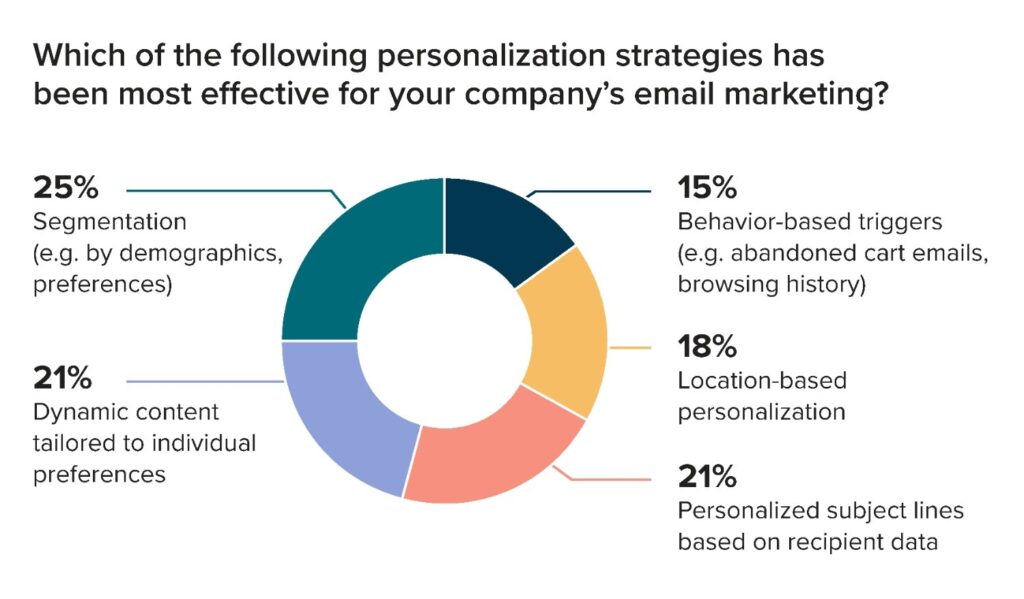
We already know that personalization is key to making your email marketing campaigns work, but have you seen what’s on email marketers’ to-do lists? There’s no way you could personalize each email to your email list without a little help. A well-trained AI learns what your users like and can help you create content that speaks directly to those preferences. It learns both from data you already have and from every interaction moving forward.
For example, it will know if Customer A has an existing internet service product and is responsive to upsells or add-ons relevant to that product. AI can add them to (or create) the appropriate customer segment for that sort of content automatically, without the marketer needing to comb through individual customer data to do it manually. It might also learn if Alice only responds to content featuring special offers or recommendations, enabling your marketers to use generative AI to quickly create content that speaks to that preference.

For example, in this dynamic email, AI uses a personalized image to grab the recipient’s attention and encourage them to shop their Black Friday deals.
It also saves time by helping marketers build personalized content at scale. Instead of needing to write 10 versions of an email for 10 different audiences, a marketer can write one version, then use AI to tailor a version of it for each audience or add in dynamic content.
4. Optimize your email send time and frequency based on subscriber preferences
Predictive AIs are now in many ESPs, which can identify when customers have historically been most responsive to email and tailor send times so your emails reach them at the best possible time. It can also detect patterns and report if some customers are seeing too many (or too few) messages, so your marketers can adjust the frequency of their outreach.
From there, they can suggest, test, and refine different subject lines and strategies. They also quickly figure out:
- When each customer is most likely to respond to an email.
- Which customer needs a steady drip of marketing to keep them engaged.
- Which customers are better off being left alone for a while between each message.
AI turns email marketing at scale from largely a guessing game into an exact science, and a fairly low-effort one at that.
5. Automate time-consuming manual tasks and simplify email production workflows
Automating time-consuming and monotonous tasks frees up your marketing and sales teams to focus on big picture ideas, long-term strategy, and conversions, instead of spending hours per day combing through data or plotting out email send-times customer by customer.
You can use AI to templatize your work more quickly, including copy, image, and coding notes that exist in almost every campaign. (I mean, who wants to spend hours writing alt text when you could be drafting the next big State of Email report?)
That goes for production, too. AI can help with basic code and de-bug your code more quickly. Not only does this process take a ton of time, it’s also fairly monotonous and boring to do.
Voila, AI makes it take significantly less time, freeing up your developers to do more fun stuff with their emails. For example, in this dynamic email, AI pulls in live updates about the weather in the subscriber’s area. Doing something like this would take forever for email marketers and email developers to pull off without the right tools:
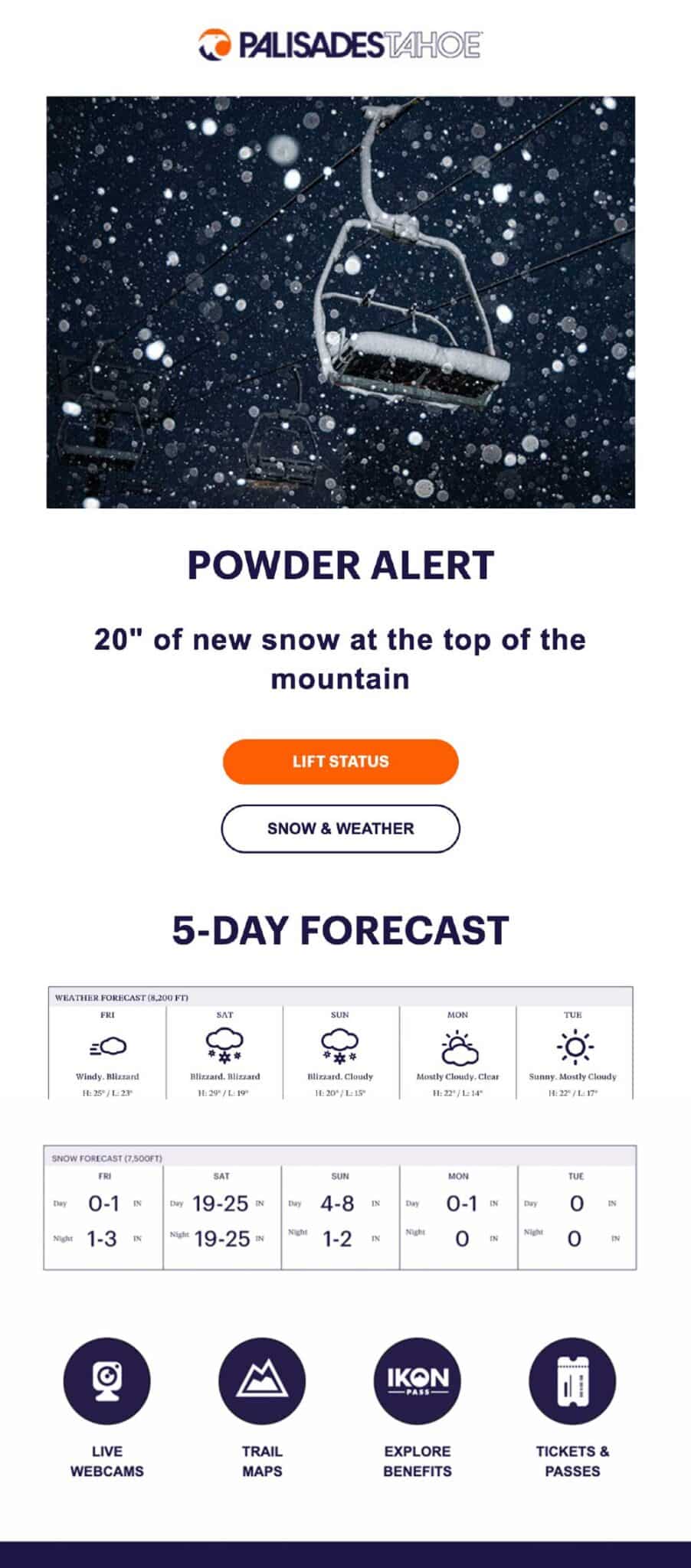
Good AI adjusts and retargets as it gathers new data. It observes customer behaviors to provide new and updated recommendations and insights based on those changing behaviors and can even forecast likely future behaviors.
6. Speed up feedback and approvals
Usually, with feedback and approvals, it goes something like this: you send a test email and forward it to the group who needs to review it. (Or send them a Litmus Proof, ahem ahem.) Either way, inevitably, someone from the reviewing group doesn’t just want to catch a typo but instead has various other eleventh-hour changes that put the email back at the drawing board.
One way AI can help free up your employees is through flow orchestration. Flow orchestration allows you to design multi-step processes that interact with multiple users and multiple systems. You can use it to create advanced approval processes, task lists for groups, or any other processes that require multiple interrelated steps.
How to use AI for email responsibly
What makes AI feel icky in an email marketing flow? When marketers forget to use their brains.
AI is a tool, just like your ESP or an email marketing testing tool like Litmus. It’s not a replacement for the best parts of your job as an email marketer, and it certainly doesn’t know your audience better than you do. That means looking critically at the output you receive and paying attention to the input of any prompts and the quality of your data.
Regardless of how you use AI, remember: Trust your intuition and judgment. Here’s how we’ve approached adding AI into our email workflow here at Litmus:
1. Vet your vendors
First things first: vet your vendors. When selecting a tool or service that’s right for you, consider:
- How are they ensuring data security? Since AI systems often rely on personal data, what are they doing to protect user data to ensure it’s private and secure?
- How are they ensuring data accuracy over time? What efforts are they making to continually monitor the accuracy of their data?
- How much visibility will you have? What large language models or data sets are they using? By getting visibility on this, you can better evaluate how much to trust the accuracy of the output.
Having this basic knowledge will help you more confidently use AI in your email day-to-day. Try to understand AI well so you can easily explain to your colleagues, customers, and subscribers the benefits and shortcomings of your selected vendor (and AI, in general).
2. Check in regularly for bias and discrimination
Another important piece is to regularly evaluate your vendors for bias’ that may be present in their models. Responsible AI practices should eliminate biases that are inherent to the models on which their systems are trained. AI systems can generate unfair outcomes, leading to the perpetuation of bias and discrimination.
Watch out for email imagery
Email marketers should be very careful when using generative AI for imagery. In 2022, researchers found DALLE-2’s depiction of people to be “too biased for public consumption,” with a strong tendency towards generating images of mostly white men by default, overly sexualized portrayals of women, and reinforcing racial stereotypes.
Although OpenAI has implemented techniques to more accurately reflect a diverse population, it’s still an imperfect work in progress.

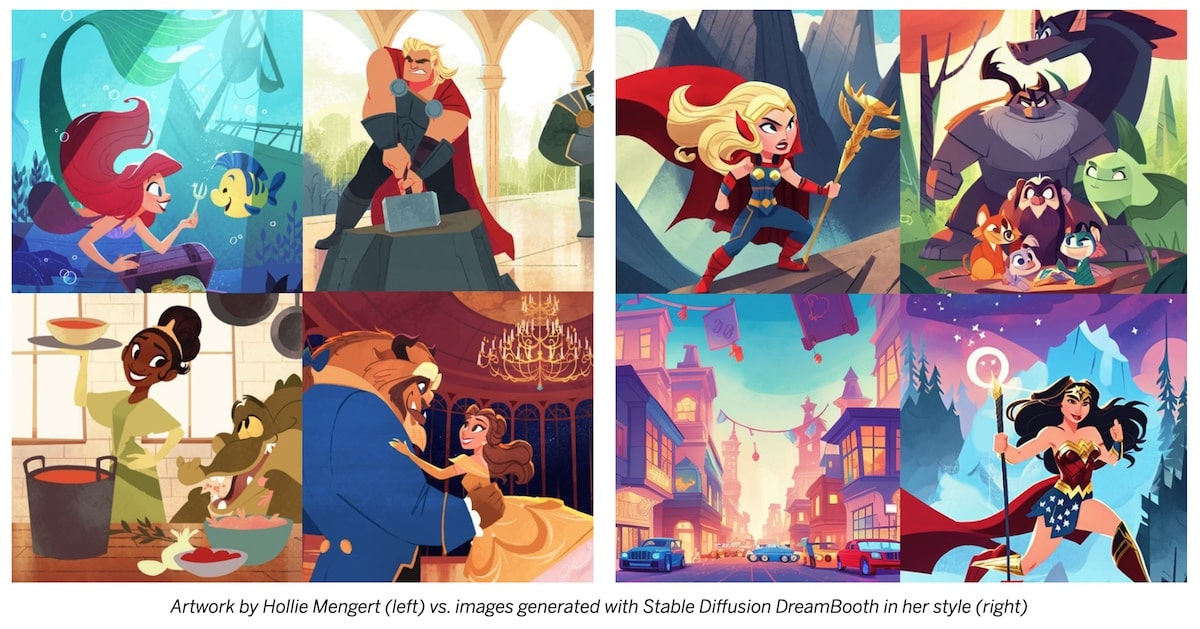
Another watchpoint to keep in mind: AI-generated imagery is trained on billions of images from the web. That includes artists’ work without their consent or permission. This is an intellectual property problem that may infringe on copyrights.
Several instances have occurred where creators and artists unwillingly found their work used to train a generative AI model. While there have been lawsuits against Stability AI and Midjourney, regulation is still in its infancy.
Watch out for email copy
Keep in mind, much like humans, no AI tool is perfect. Some have been known to produce outputs that are nonsensical or offensive. If you’re using generative AI to help write copy, take this into account. Use it as needed, but exercise caution and sound judgment.

All in all, if you’re using generative AI tools, we recommend you:
3. Be transparent
In a recent Validity survey, they asked over 1,000 consumers if they’re more or less likely to trust marketing emails they knew were written by AI. Two in five said they are “somewhat less” or “much less” likely to trust these messages.
Although lifting the marketing veil may seem counterintuitive, being transparent with your audience ultimately leads to building trust. Incorporating a few words that inform subscribers about the use of AI can easily suffice.
In a recent edition of our former newsletter Litmus Weekly—now called Litmus News—we used generative AI to assist with email copywriting. We concluded the email with a simple acknowledgement, “this email was written using Jasper,” weaving it into the copy as naturally as possible.
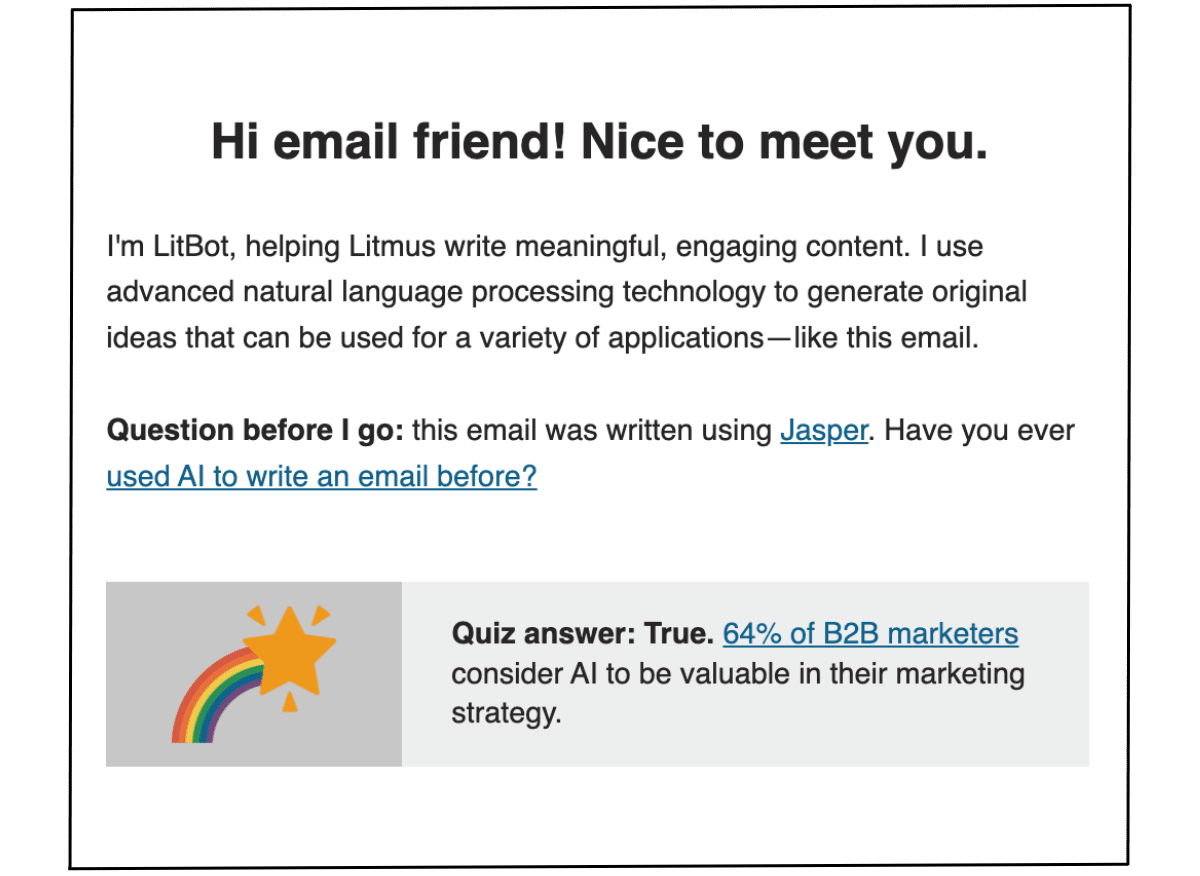
Here’s an example of an email from The New York Times that’s a little more explicit:
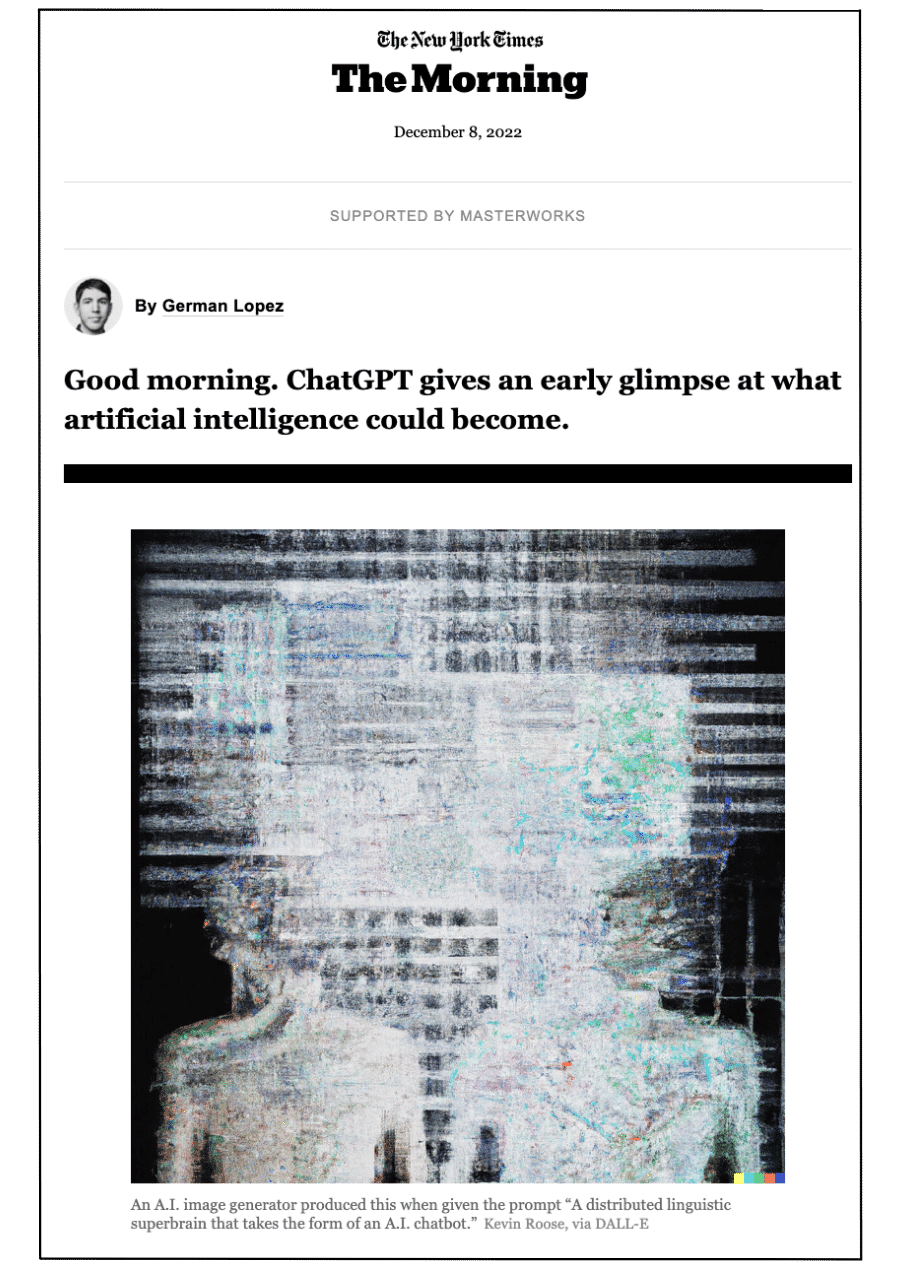
In the image caption, they specified that the image was produced with AI, even going as far to share the prompt and tool they used.
If you’re ever in doubt, give credit. A simple “powered by AI” in your email can go a long way in fostering brand trust. Marketers should update their privacy policies to be clear about their AI use and change their preference centers to let subscribers control their exposure to these changes, and even to opt out altogether from receiving AI-generated messaging.
Get started using AI for email
AI presents its fair share of risks and challenges, but it’s not the enemy. We, as the “human” part of the AI equation, should be mindful practitioners, engaging with these tools fully aware of both their capabilities and imperfections.
In the same way no marketer would go back to passing around creative briefs on paper, email isn’t going backward. As we look at the future with AI, it’s important to remember what makes email the most personal, trusted marketing channel: it’s humanity.
What people miss in the use AI/don’t use AI debate is that automating repetitive tasks or data analysis with AI can unlock so much more personalization and humanity in our strategic approach, our copywriting, and leave room for the bells and whistles we love to put into our email designs.
Learn more about how Litmus can help you use AI for good > https://www.litmus.com/ai-emerging-email-technology

Kayla Voigt is a B2B Freelance Writer.