Key takeaways ✨
|
Valentine’s Day is one of the biggest events on the email marketing calendar. In 2026, US consumers are expected to spend $29.1 billion on Valentine’s Day, or approximately $199.78 per individual.
This spending won’t be just for romantic partners—shoppers will buy gifts for friends, co-workers, classmates, teachers, and even pets.
But Valentine’s poses some unique challenges for marketers. The promotional window is narrow, the shelf life of typical products is often very short, and there’s a big gap between consideration (which occurs weeks before) and purchase (which occurs days before).
So, how can email marketers deliver great campaigns on Valentine’s Day—and beyond? In a previous episode of Validity’s State of Email webinar, Guy Hanson spoke with Hickory Farms’ Jen Partin, PrettyLitter’s Matthew Seifert, and eFocus Marketing’s Kate Barrett to get their expert guidance.
Table of Contents
- Proactive planning
- The role of AI in Valentine’s messages
- Empathy is essential
- Galentine’s is great
- Showing the love all year long
Proactive planning
Benjamin Franklin famously said, “By failing to prepare, you are preparing to fail.” Abraham Lincoln’s version was, “Give me six hours to chop down a tree, and I will spend the first four sharpening the axe.”
These are great guiding principles—and Guy asked Jen, Matthew, and Kate how the importance of preparation maps back to email marketing.
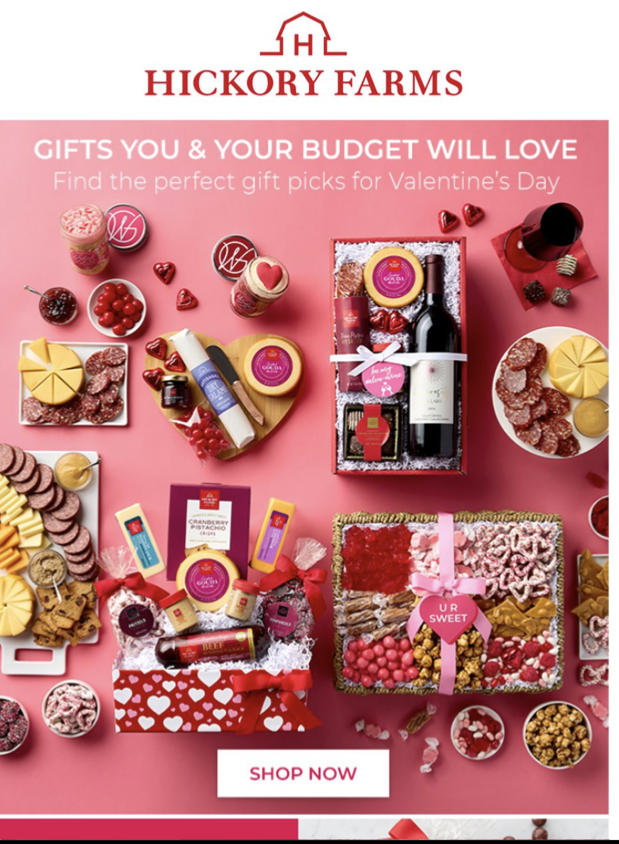
For food gift retailer Hickory Farms, customer demand is highly seasonal. Planning for Valentine’s Day starts in Q4 of the previous year. This preparation includes creating creative briefs, finalizing photography, and doing lots of awareness-building because shipping deadlines are a week before the big day!
Different Hickory Farms customer segments receive different offers, including emails promoting core products with a Valentine’s theme, a “storytelling” version with fun ideas for date night, and a budget-friendly version to help money-conscious customers.
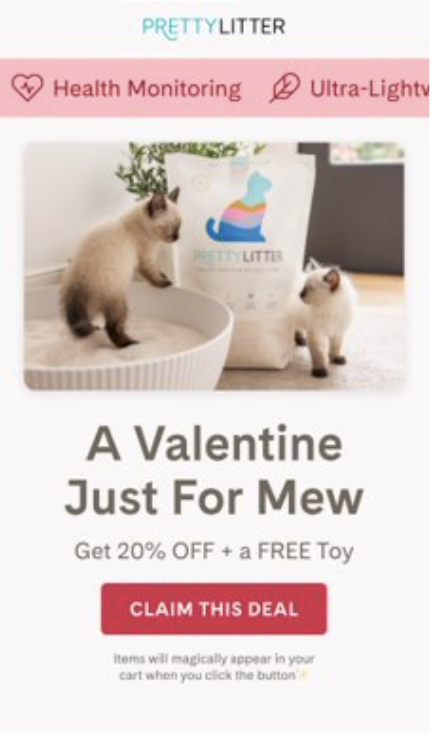
For cat litter provider PrettyLitter, Valentine’s Day is an opportunity to have some fun. The team uses playful language to focus on the love between customers and their cats. Lead-up starts around two weeks before the big day, and their cross-channel email and SMS campaigns focus on tugging at heartstrings.
Who can resist subject lines like, “It’s a Purr-fect Match for Your Cat’s Litter Box”? (Last year was all about “Feline the Love!”)
Specialist email marketing agency eFocus Marketing works with a broad list of global senders. Kate draws on her wealth of experience to advise the following:
- Use the post-holiday period to review active and inactive data segments.
- Analyze purchase/engagement data from this period.
- Use these insights to inspire customers by connecting them with your product catalogue using refreshed personalization and messaging strategies.
Go beyond opens and clicks
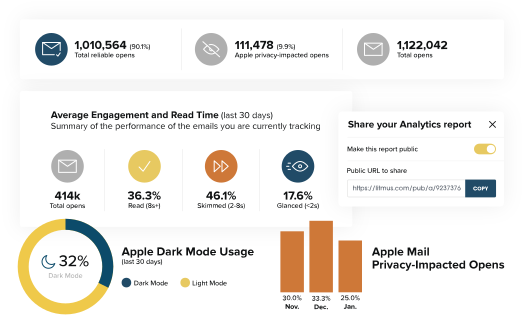
Brands that use Litmus Email Analytics see a 43% higher ROI than those that don’t. See what you’re missing. Learn more.
The role of AI in Valentine’s messages
Artificial intelligence (AI) has gone from a buzzword to a standard practice in email marketing—and it’s changing what’s possible for seasonal campaigns like Valentine’s Day.
According to Litmus’s State of Email report 2025, there was a 340% increase in marketers using generative AI for tasks like copy and image generation, personalization, and A/B testing between 2024 and 2025. You can clearly see the impact of AI in campaign speed: in 2024, 62% of email teams said they needed two weeks or more to produce a single email, and that number dropped to just 6% in 2025.
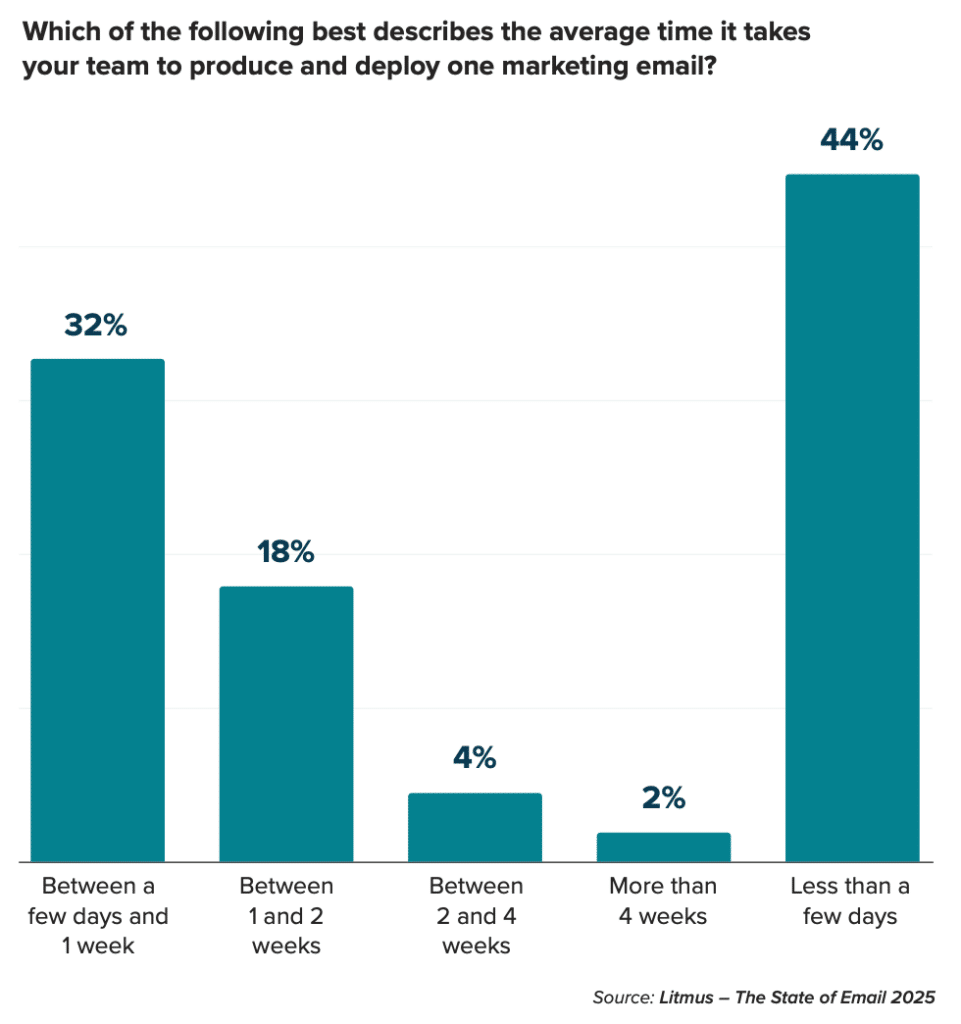
That speed advantage is especially valuable during tight promotional periods, like Valentine’s Day, where campaigns cannot be delayed without missing their window.
But AI should not be used as a replacement for creative judgment. The most effective applications include generating campaign concepts from first-party data, producing multiple personalized content variations for different segments, and using AI-assisted tools to optimize subject lines and copy—all while being checked and polished by a real human on the team.
Looking ahead, 70% of email marketers say they expect up to half of their email marketing operations to be AI-driven by the end of 2026. For Valentine’s Day and beyond, the opportunity isn’t just in using AI—it’s using it thoughtfully to deliver more relevant, personal messages at scale.
Get email insights from marketers worldwide
Dive into the State of Email Reports for the latest trends, innovations, and best practices across the email marketing industry.

Empathy is essential
Sensitive marketers understand Valentine’s Day isn’t for everyone. Customers may be single, experiencing a recent breakup, or dealing with the loss of a loved one. With this in mind, offering a temporary opt-out (“snooze”) option should be an essential best practice.
Guy asked our State of Email webinar audience how many have this in place.
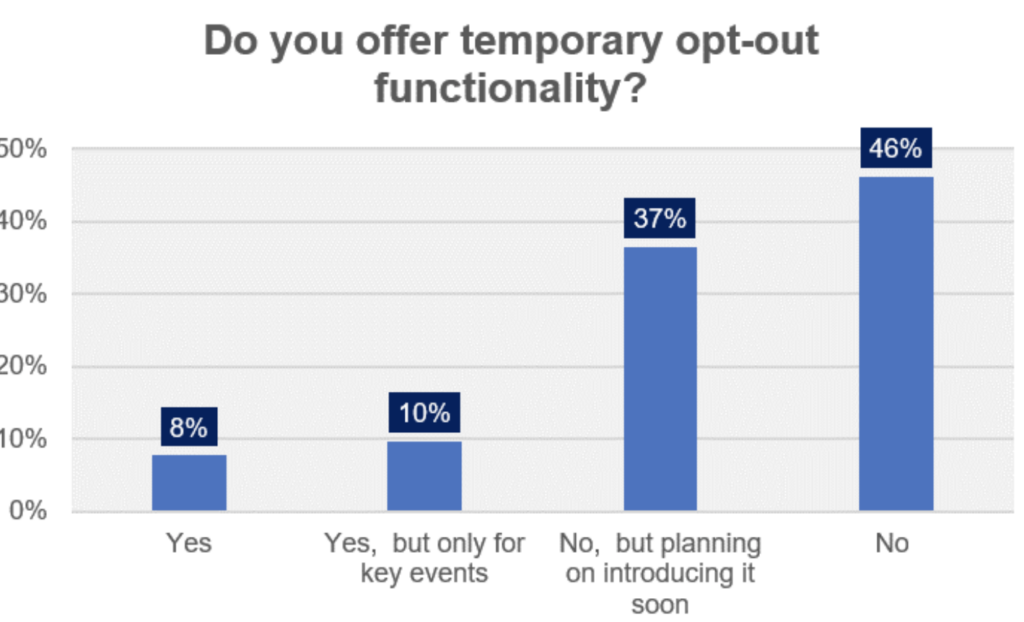
The low adoption reported is surprising—in addition to showing consideration to customers, email programs using this feature also benefit from reduced list churn. Oracle research shows that the use of the snooze option typically decreases permanent unsubscribes by over 82 percent.
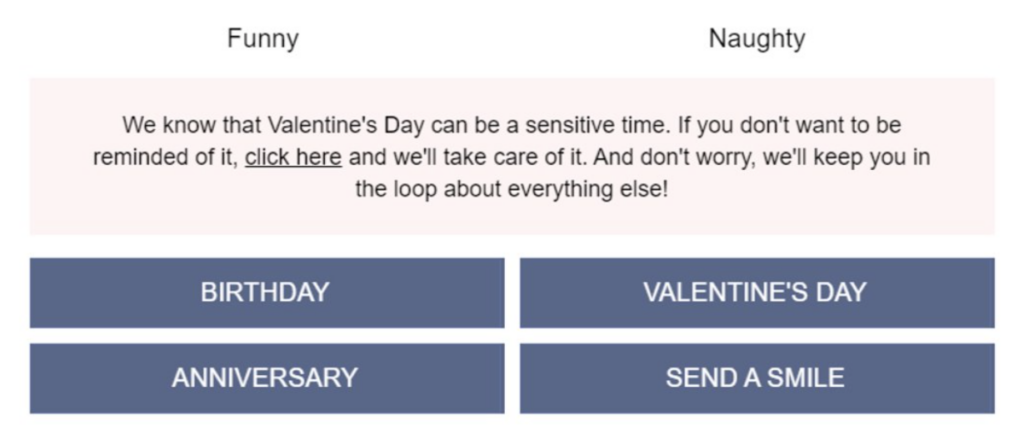
Senders can also be proactive in gauging these preferences. Knowing subscribers’ communication preferences for events like Valentine’s, birthdays, and anniversaries in advance means they can personalize more effectively using these valuable first-party data points.
Galentine’s is great
Galentine’s Day has risen in popularity, becoming a semi-official day for people to celebrate their non-romantic friendships. Hickory Farms understands the importance, and it’s a key part of their messaging.

Marketers should recognize that this day resonates with those outside of established couples. This email provides readers with gift ideas, suggestions on how to celebrate with their besties, and even a blog article that explains the “holiday” in more detail.
Design tools anyone can use
Easily build on-brand, accessible emails using our drag-and-drop builder and templates.

Showing the love all year long
There’s an old saying that the best relationships celebrate Valentine’s Day every day of the year. Guy asked the experts how senders can show love to their email programs all year long.
- Jen keeps her finger on the pulse of her subscriber engagement, holding post-campaign briefings to learn what worked and what didn’t, and conducting nonstop testing.
- Matthew focuses on data quality to build a foundation for email success. PrettyLitter uses BriteVerify from Validity to validate all new email addresses and mobile numbers at point of sign-up, and they run automated processes to re-validate them on a regular basis. Great data means great deliverability and big benefits for subscriber engagement.
- Kate analyzes behavioral data to understand how subscribers are engaging, then uses these insights to optimize future performance. She also uses MailCharts from Validity for email examples to keep her messaging fresh and engaging for subscribers.
Although some of these email examples are Valentine’s-centric, these principles are evergreen and can be applied to other key email events like Mother’s Day, Father’s Day, Black Friday weekend, and even the periods in between.
To hear more insights from these experts, watch the recording of our State of Email webinar on-demand. →
This article was originally published on Validity.
The info in this blog is 2+ years old and may not be updated. See something off? Let us know at hello@litmus.com.

Matt is a Content Marketer at Validity